Public festival · two days
Saint Petersburg tea festival 2026 — autumn
Two days at the Manège with sixteen vendors, four gongfu sessions a day, and a quiet focus on Phoenix Mountain *dāncōng* (单丛) — the autumn pick from Guangdong, poured slowly for visitors who want more than a tasting flight.
- When
- 2026-10-04
- Where
How the two days unfold
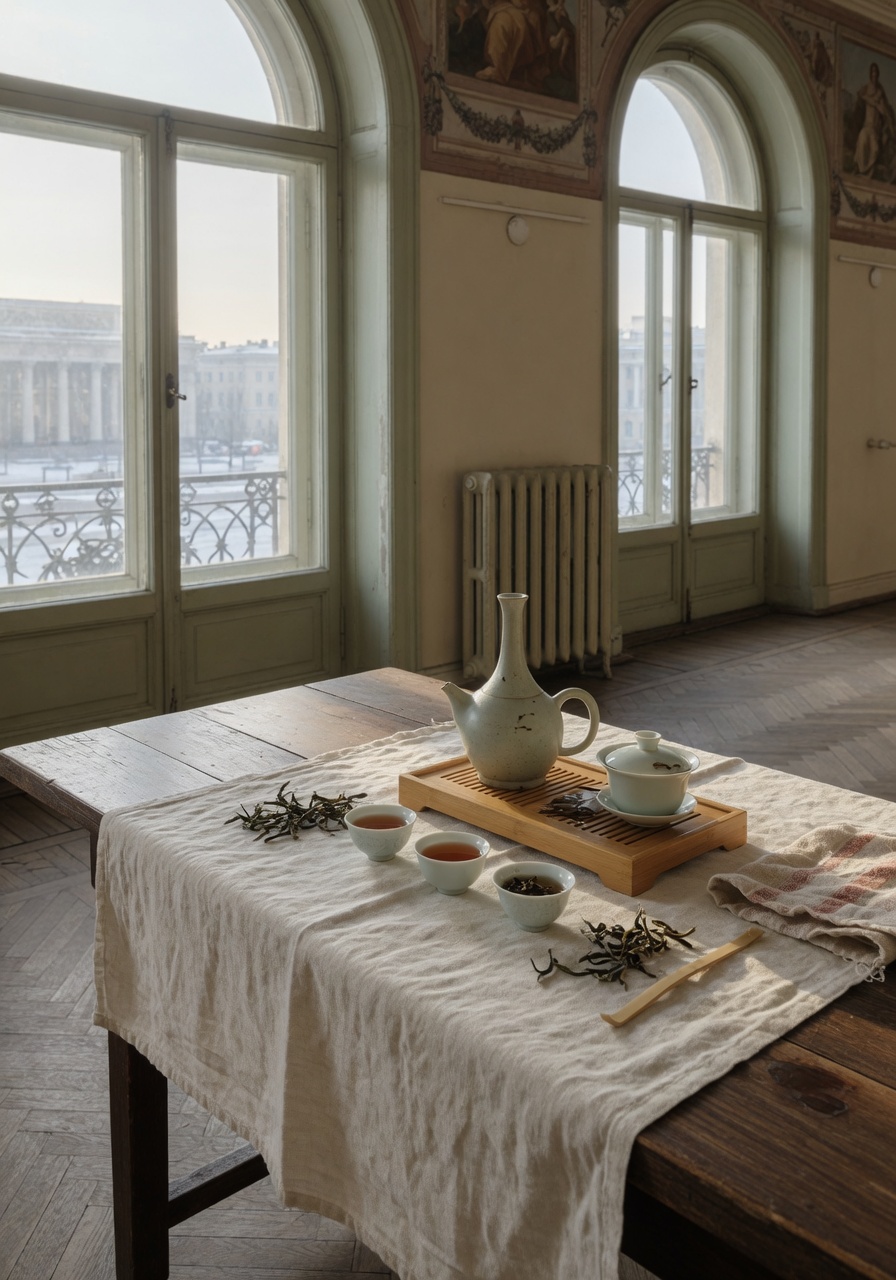
The festival opens on Saturday 4 October at ten in the morning, when the doors of the Manège exhibition hall swing into the courtyard and the sixteen vendor tables are already set — kettles steaming, scales tared, sample tins lined up by harvest year. The ground floor belongs to the traders: Yunnan Shēng Pǔ’ěr (生普洱) pressed in spring 2024, a Hunan stand showing four hóng chá (红茶) lots from Anhua, two Fujian houses with white tea cakes from 2019 onward, and — this year’s heart — a long bench of Guangdong dāncōng (单丛) cultivars from Phoenix Mountain, including the Mí Lán Xiāng (蜜兰香) honey-orchid type that Mei Yang has been working with for over a decade.
Mornings are unhurried. From ten to one, visitors walk the floor, taste at vendor tables, ask questions, weigh things, talk price. There is no programmed urgency. The mezzanine holds the four gongfu sessions — each runs ninety minutes, seats twelve, and pours through three to five teas with a single master at the table. Saturday’s lineup begins with Mei Yang on Phoenix dāncōng (a vertical of three Mí Lán Xiāng lots from 2022, 2024, and 2025), followed by Chen Hui Yi on white tea aging in the early afternoon, and Zhou Xiang on Hunan black tea at four. Tickets for the gongfu mezzanine are separate from the day pass and limited; the schedule is published one week before the festival on tea.school.
Lunch is built into the floor plan. Two food stands run continuously — a Buryatia table with buuzy and broth, a vegetarian Petersburg kitchen with simple grain bowls — and there is no need to leave the building. By three in the afternoon the hall is loud in a good way: the acoustic of the Manège swallows speech well, but cups still ring on saucers and the kettles whistle.
Saturday closes at eight with an open cupping in the main nave. Six teas, blind, scored on a simple sheet, results read aloud. It is collegial rather than competitive. Most people stay for a glass of something afterward.
Sunday 5 October opens an hour later, at eleven, with a slower rhythm. The vendor floor is the same but quieter, restocked from morning deliveries. The mezzanine programme repeats Saturday’s three gongfu sessions for those who missed them, and adds a fourth at two in the afternoon — a conversation between Mei Yang and two visiting growers from Chaozhou about the 2026 autumn harvest specifically, what the weather did to the leaf, and what is on the tables this weekend as a direct result. Translation is provided.
The afternoon includes a short film programme — three documentary shorts on Yunnan, Hunan, and Guangdong production, shown on loop in the side gallery — and a tea-equipment corner curated with tea.equipment, where visitors can handle gaiwans, kettles, and pots before deciding what to take home. Members of tea.community receive a small discount at participating vendors; the festival accepts the standard membership card at the door.
The festival closes Sunday at seven. Vendors pack down slowly. Most return next April for the spring edition.
What you get
-
Two-day access to the vendor floor with sixteen Chinese tea houses representing Yunnan, Hunan, Fujian, Guangdong, and Anhui
-
Tasting cups on a lanyard, refilled at any vendor table — no extra charge for samples poured at the floor
-
Printed programme with vendor map, cultivar notes, and the autumn 2026 dāncōng (单丛) guide written by Mei Yang
-
Access to the open cupping on Saturday evening — six blind teas, scored collectively, results read at the table
-
Discounted entry to the tea.equipment corner for handling kettles, gaiwans, and Yixing pots before purchase
-
Free entry to the side-gallery film programme on Yunnan, Hunan, and Guangdong production
-
Festival booklet that doubles as a tasting journal for the weekend
Practical notes
-
Where — Manège exhibition hall, Saint Isaac’s Square 1, Saint Petersburg. Metro Admiralteyskaya, eight minutes on foot. Step-free entrance from the courtyard side.
-
Hours — Saturday 4 October, 10:00–20:00. Sunday 5 October, 11:00–19:00. Gongfu mezzanine sessions run on a separate schedule published one week in advance on tea.school.
-
Language — Russian and English on the floor. Mandarin available at most vendor tables. Mezzanine sessions are bilingual Russian–English with consecutive translation for visiting growers.
-
Food and drink — Two food stands inside the hall — Buryatia kitchen and a vegetarian Petersburg kitchen — running through both days. Water is freely available. Tea is, of course, everywhere.
-
Dress and weather — Saint Petersburg in early October is cool and damp, expect 6–10°C with rain likely. The Manège is warm inside. Layers and waterproof shoes are sensible. No dress code on the floor.
-
Accessibility — Step-free access to the ground floor and side gallery. The mezzanine is reachable by lift on request — ask at the entrance desk. Hearing-loop available at the cupping table.
-
Tickets and discounts — Day pass from €18, two-day pass €30, gongfu mezzanine sessions €15 each, booked separately. Members of tea.community receive a 15% discount on the two-day pass with their card at the door.