home · discussion
Field notes
Big festivals vs private sessions — what each format actually gives you
Two hundred people in a convention hall versus six around a master's table in Wuyi. Both are useful. They give you completely different things, and confusing the two leads to disappointment on both sides.
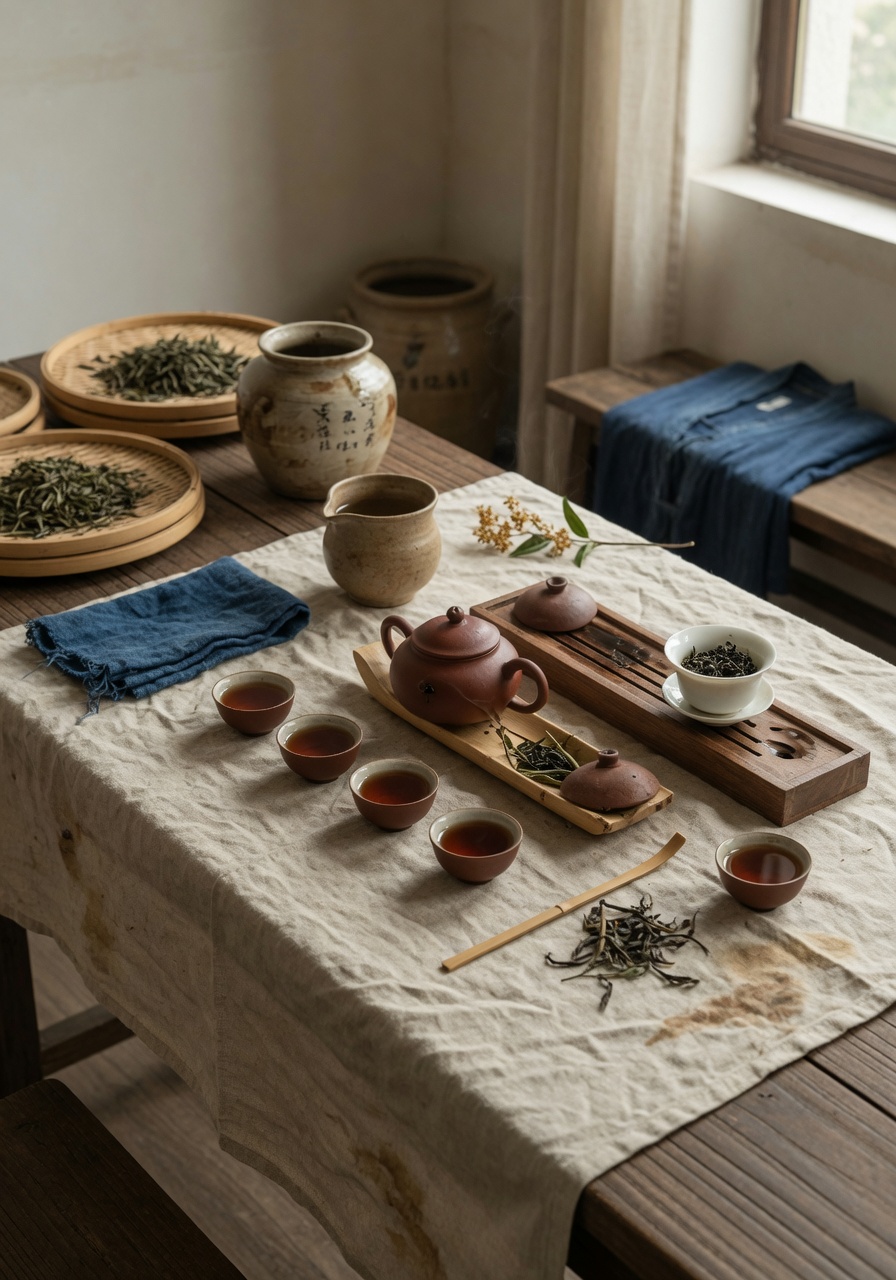
Every spring I get the same question from people who are starting to take Chinese tea seriously: should I fly to the big festival in Hangzhou or save the money for a small private session with a working maker. The honest answer is that these two formats are not in competition. They solve different problems. A festival is a survey instrument — wide, shallow, full of contradictions. A private session is a depth instrument — narrow, slow, one voice taking responsibility for what is in your cup.
I have spent the last decade moving between both. I have poured at a 400-person Tiě Guān Yīn (铁观音) cupping in Xiamen where the table next to mine was running burnt charcoal roasts to mask weak leaf, and I have sat for four hours in a Phoenix Mountain studio with a Mí Lán Xiāng (蜜兰香) maker who refused to brew the third vintage because he said the water that day was wrong. Both experiences were valuable. Neither could have substituted for the other.
What usually goes wrong is expectation mismatch. People show up to festivals expecting intimacy and leave overwhelmed. They book private sessions expecting variety and feel cheated when the host pours four iterations of the same leaf. The format dictates what you can learn, and once you understand that, you can build a year that uses both well.
This thread is meant as a practical comparison from inside the work, not a ranking. I will go through what each format genuinely gives you, where each one fails, and how I personally sequence them across a season. If you are planning travel for 2026 — and the spring Wuyi calendar on tea.travel is already filling — this is the conversation to have first.
What a festival actually gives you
A large festival — Xiamen International Tea Fair, the Hangzhou spring expo, the Guangzhou autumn edition — is a calibration tool. You get to taste fifteen versions of the same category in a single afternoon. Last April in Xiamen I cupped twenty-two Dà Hóng Páo (大红袍) submissions in under three hours. None of them were the best Wuyi rock tea I have ever drunk. That was not the point. The point was that by the end of the session my palate had a recalibrated baseline for what mid-tier commercial Dà Hóng Páo actually tastes like in 2025 — the average roast level, the average mineral expression, the price floor. That kind of horizontal sweep is impossible in a private setting. No single master will ever pour you their competitors’ work honestly.
The second thing festivals give you is faces. You meet the people behind the names you have only read on cake wrappers. You see who is friends with whom, which cooperatives are quietly merging, which young makers are being courted by Hong Kong buyers. The politics of the industry is on display in a way that no online forum will reveal. I cross-reference what I see at festivals with the maker directory on thetea.app to keep my notes accurate.
What festivals do not give you is depth. You will not understand a single tea after a festival. You will understand the category.
What a private session actually gives you
A private session is the inverse. Six people around a table, one host, one leaf or maybe a vertical of three vintages, three to four hours. The economic model is different — you are paying for the host’s undivided attention and for the cost of opening genuinely good material that cannot survive being poured for two hundred strangers.
Last November I sat with a Chaozhou-region maker who works almost entirely with Yā Shǐ Xiāng (鸭屎香) from a single ridge above his village. He poured the same leaf in three different waters — local spring, bottled mountain water from Fujian, and filtered Guangzhou tap — and made us sit with each one for twenty minutes. By infusion six I could taste the difference between the waters without looking at the kettles. That lesson took half a day. It is the kind of thing you cannot bullet-point. You have to be in the room.
Private sessions also give you permission to ask stupid questions. In a festival hall, asking why a roast tastes ashy gets you a defensive answer from a sales rep. In a small studio, the maker will tell you that batch lost humidity control in week three and he is debating whether to re-roast or sell it cheap. That honesty is the actual product. For long-form reading on this kind of process honesty, the storage and roast journals on puerh.app are the closest written equivalent.
Where festivals fail — and where private sessions fail
Festivals fail at trust. The economics push exhibitors toward presentation rather than truth. A table at the Hangzhou expo costs real money, the staff are often hired for the week, and the leaf on display is usually the upper-middle of what the company makes — not the top, because the top is reserved for direct buyers, and not the bottom, because that would be embarrassing. So you are tasting a curated middle. If you mistake that middle for the maker’s actual range, you will buy badly later.
Festivals also fail at sensory conditioning. The halls are loud. The air carries thirty competing aromas. By hour two your nose is fatigued and you are making decisions you cannot defend the next morning. I now refuse to buy anything at a festival on the day. I take notes, request samples, and decide a week later in a quiet kitchen.
Private sessions fail differently. They fail at breadth and at price discovery. If your only exposure to Shuǐ Xiān (水仙) is the version one Wuyi master pours you in his own studio, you have no idea whether his price is fair, whether his roast philosophy is the regional consensus or his own preference, whether the bushes he sources from are old or young. A private session is one perspective rendered with great care. It is not the field.
They also fail at network. You will not meet other drinkers at a six-person session in the way you do bumping into people in a festival queue. The community side of this — the keeper system and regional meetups on tea.community — is genuinely better discovered at large events.
How I sequence a year
My working rhythm, which I recommend to anyone serious: one big festival per spring for survey, two or three private sessions across the year for depth, and the rest of the time at home drinking what you bought as a result. This is roughly what tea.school recommends for second-year students, and after a decade I have not found a better cadence.
The spring festival — Hangzhou or Xiamen — is for the new harvest. You calibrate your palate against the year’s Lóng Jǐng (龙井) and early Wuyi roasts. You write down everything. You buy nothing on site.
In early summer I book one private session in whichever region had the most interesting expression at the festival. Last year that was Phoenix Mountain in Guangdong; this year it will probably be northern Fujian. The point of this session is to understand one maker’s complete vocabulary — every leaf they make, in order, with their own commentary. By the end you have one trustworthy reference point inside a region.
Autumn is for pǔ’ěr (普洱) — the Guangzhou fair and then a single studio session in Kunming or Yiwu. The Guangzhou fair is unmatched for vertical comparison of aged Shēng Pǔ’ěr (生普洱). The studio session is where you learn what one specific mountain tastes like when the maker is not performing.
Winter is for sitting still and drinking through what you accumulated.
The cost question, honestly
A flight to the Xiamen fair, three nights in a mid-range hotel, festival admission and sample purchases — call it 8,000 RMB for a foreign visitor doing it modestly. A private four-hour session with a recognized maker in Wuyi or Chaozhou — 1,500 to 4,000 RMB per seat, often with leaf included that would retail far higher.
Per hour of useful learning, the private session is cheaper. Per leaf surveyed, the festival is cheaper. Neither is a luxury once you understand what you are buying. The mistake is paying festival prices and expecting studio depth, or paying studio prices and being disappointed there were only three teas on the table.
For anyone building a 2026 itinerary, the cross-referenced regional calendar on tea.travel lists both fair dates and confirmed private-session hosts side by side, which is the easiest way to plan a trip that uses both formats deliberately. The equipment side — gaiwan weights, kettle choices for travel — is on tea.equipment if you are flying with your own gear.
Open questions for the thread
Three questions for the thread. First — what was the most useful thing you learned at a large tea festival, and would you have learned it any other way? Second — for those who have done private sessions with working masters, what made the session worth the cost, and what would you change about how you prepared? Third — if you only had budget for one format next year, which would you choose and why?