home · discussion
Practice & etiquette
Bringing children to a tasting — when it works, when it doesn't
Notes from a Guangdong tea worker on what actually happens when an eight-year-old sits down at a six-cup gōngfū (功夫) table. The honest version, not the photogenic one.
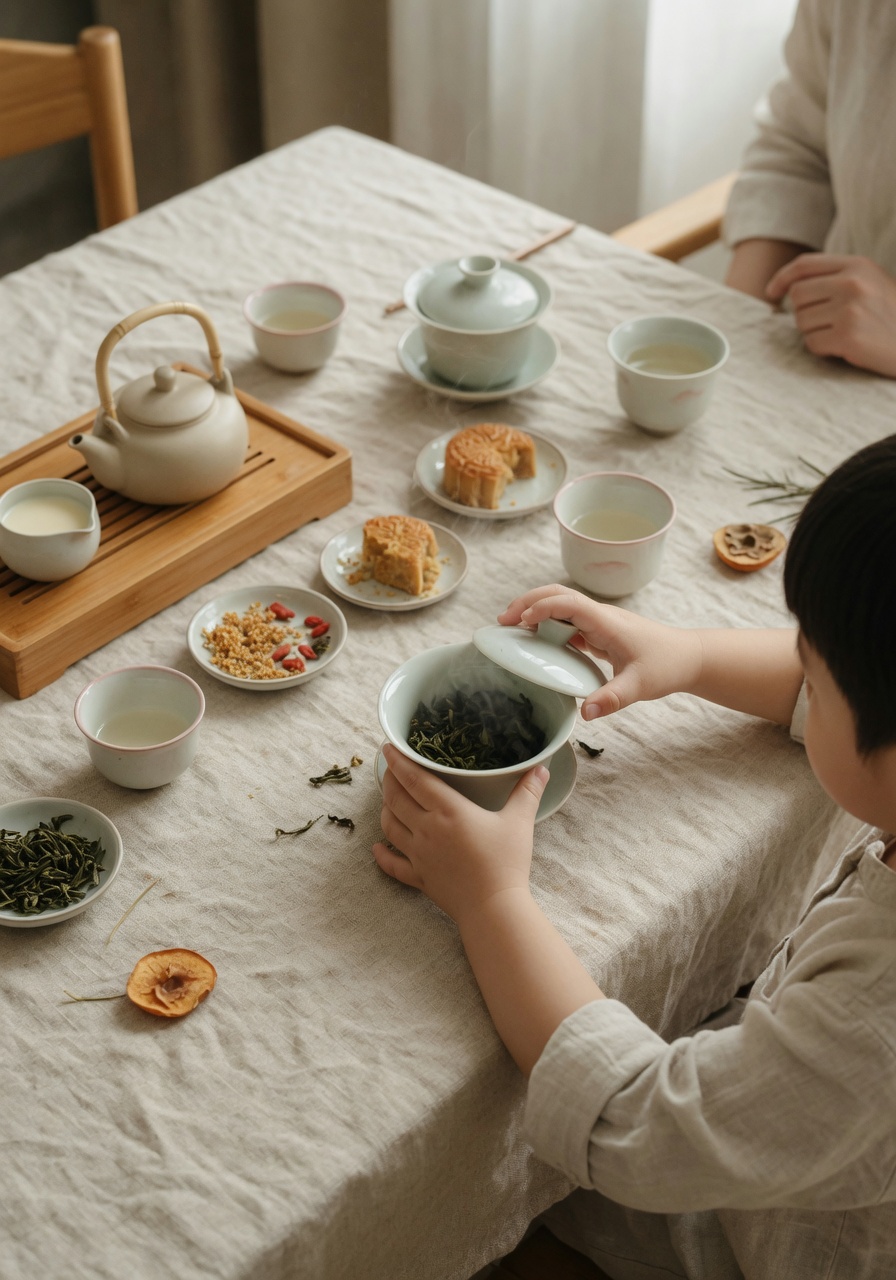
The question came up three times last month in the tea.events host channel, and once from a member who had been told, politely but firmly, that her nine-year-old was welcome to wait in the lobby. I want to write something honest about this, because the romantic version — child sits cross-legged, sips bái háo yín zhēn (白毫银针) from a tiny cup, says something wise — is mostly fiction. The real version is more interesting and, I think, more worth defending.
I have been pouring tea for guests in Chaozhou and Shantou since I was nineteen, which means I have hosted hundreds of sessions where a child was present, either as a guest or as the host’s own kid orbiting the table. The good sessions and the bad sessions are not random. There are patterns. The variables are caffeine load, session length, what the child is asked to do with their hands, whether anyone has explained the wrapper ritual to them, and — most underweighted — whether the adults in the room are willing to slow their own pace by about thirty percent.
What follows is what members have shared in the thread plus what I have observed at our small Guangdong tastings. None of it is a rule. All of it has worked at some table and failed at another. If you have hosted a child in a gōngfū session and have a counter-example, that is exactly what the discussion at the bottom is for. We also keep a longer practitioner conversation on tea.community where the keeper notes from the past two years are searchable, and I will reference a few of those threads inline.
The age floor is closer to eight than to twelve
The number that keeps coming up in member reports is eight. Below that, the session has to be designed around the child rather than the tea, which is a different event and a worthwhile one but not what most hosts plan for. From around eight, a child can sit through a forty-minute session if the structure is clear, if they are given a small job (more on that below), and if no one is performing for them.
A member in Chengdu who hosts monthly family tables told the thread that her own daughter started joining at seven and was the youngest at the table until she turned ten. The shift she noticed at eight was not attention span — it was the ability to wait. A seven-year-old wants the next cup now. An eight-year-old can watch the leaves open in the gàiwǎn (盖碗) and accept that the first infusion of a 2014 Phoenix dāncóng (单丛) from Wūdòng Shān (乌岽山) needs to rest for thirty seconds, and that the wait is part of what they are tasting.
The reverse boundary matters too. Teenagers who are dragged to a session because the parent thinks it will be ‘good for them’ are often worse company than an enthusiastic eight-year-old. The willingness gradient is more predictive than the age.
Caffeine — the conversation we keep avoiding
I want to be specific here because the thread has been vague about it. A standard six-person gōngfū session of a roasted Wǔyí (武夷) oolong, say a medium-fire Ròu Guì (肉桂) from the Niúlán Kēng (牛栏坑) area, will run eight to twelve infusions across roughly seventy-five minutes. Each guest receives perhaps 25–30 ml per pour. The total caffeine intake for a child over that session is meaningful — comparable to a small cup of brewed coffee, possibly more depending on leaf-to-water ratio.
What has worked at our tables: pour the child the first two infusions at adult strength, then switch their cup to the rinse water or a parallel pot of lǎo bái chá (老白茶) cake from 2017 or earlier, which after long storage carries far less perceived stimulation and a softer mouthfeel that children actually tend to prefer. A 2015 shòu méi (寿眉) cake brewed grandpa-style in a separate jug is forgiving and lets the child rejoin the rhythm of the table without being chemically wound up by hour two.
The equipment notes on tea.equipment include a small-jug setup that some hosts use specifically for this — a 150 ml side pot kept warm on a separate plate. Worth reading if you host families regularly.
The cake-wrapping ritual as the real hook
This is the part the thread keeps returning to, and I think correctly. The single most reliable way to include a child in a pǔ’ěr (普洱) session is to give them custody of the wrapper. Unwrapping a 357 g cake of shēng pǔ’ěr (生普洱) — the careful folding back of the cotton paper, the smell of the zhú ké (竹壳) bamboo skin if it is a tǒng (筒), the inspection of the inner ticket — is a five-minute ceremony that an eight-year-old can do better than most adults because they have not yet learned to rush it.
A host in Kunming wrote in the thread that her godson, age nine, has been the official wrapper-keeper at her Saturday sessions for two years. He folds, he flattens, he files the ticket. When the session ends he rewraps the cake. He has handled cakes from the 2008 and 2012 vintages discussed in the recent shu-aging notes on puerh.app and has never damaged one, which is a better record than several adult guests I could name.
The job matters because it gives the child a reason to be at the table that is not ‘be quiet and learn’. It is participation in the material handling of the tea, which is most of what a gōngfū session actually is once you strip away the talking.
When it doesn’t work — the honest list
Sessions where bringing a child has gone badly, from the thread and from my own tables: any tasting marketed as ‘rare’ or ‘flagship’ where adult guests have paid a premium and expect a contemplative pace. Any session longer than ninety minutes. Any session where the child is the only one under thirty and no one has thought about what they will do for the second hour. Any session where the host is also the parent and is therefore performing two roles at once, badly.
Also: sessions in cold rooms. Children get cold faster than adults and a cold child is a restless child. The tea travel notes on tea.travel from the Yúnnán (云南) spring trips last year mention this specifically — the mountain tea-room mornings in Yìwǔ (易武) are beautiful but require an extra layer for anyone under twelve, and the hosts learned this by hour two of a four-hour session.
The failure mode is almost never the child. It is the mismatch between what the adults wanted from the session and what the room could actually deliver. If you can name what you want from the session before the child arrives, you can usually decide honestly whether they should be there. If you cannot name it, the answer is probably no, and that is fine — there will be a family-shaped session next month.
Designing a child-friendly format from scratch
Some hosts on tea.events have stopped trying to fit children into adult sessions and started running parallel formats. The shape that has worked: forty-five minutes, four to six guests including one or two children aged eight to twelve, three teas total. Open with a white tea — a fresh bái mǔdān (白牡丹) from Fúdǐng (福鼎) is ideal, low caffeine perception, sweet, forgiving of temperature. Middle tea is the one the child handles materially: a small shú pǔ’ěr (熟普洱) cake they unwrap, with the wò duī (渥堆) processing explained in two sentences, no more. Close with a fragrance tea the child can smell-test — a Mì Lán Xiāng (蜜兰香) dāncóng from the Phoenix mountains has the honey-orchid note that children identify immediately and remember.
Keep the session to one table, one host, no second pourer, no music. Let the child ask questions and let the adults answer them properly. The format that fails is the one that tries to be a grown-up tasting with a child quietly tolerated in the corner. The format that works is the one designed honestly for a mixed table from the start.
For hosts thinking about this seriously, the family-format module in the tea.school curriculum covers session design and there is a short practitioner course on tea.degree that includes a child-inclusion case study from a Buryatia tea-room in Ulan-Ude. Both worth a look before your first attempt.
Open questions for the thread
Three questions for the thread — what is the youngest age at which a child has actually contributed something to your session rather than tolerated it? Which tea category do children at your table consistently prefer, and does it match what you would have predicted? Have you ever had to ask a parent to take a child out of a session, and how did you handle it?